Over the last few years, we've greatly improved the landscaping of our home in downtown Little Rock. This year, we decided to dilineate the beds from the yard to reduce difficulty trimming and handling weeds. Instead of using a metal or plastic border, we simply used a hose pipe to trace out a snaking border line for several beds, and dug a trench using a square transfer shovel. The trench is about four inches deep, and angled on one side, which allows for the mulch to fall into the trench and cuts the roots of the grass. We lined the beds with builder's paper or newspaper to stop the weeds, then shoveled on a few inches of mulch. In all we made around half a dozen trips to the nursury to buy black dyed cedar mulch, each time filling the bed of my '96 Toyota Tacoma with about a cubic yard of material.
The beds turned out beautifully, but the paper did not stop the bermuda grass from tunneling up to the surface. Next year, I'll use a sturdier biodegradeable barrier like cardboard. This season I'll try sethoxydim such as in Fertilome Over The Top II.

The pride of our front garden this fall was our collection of rose bushes on each side of the front sidewalk, which exploded with vibrant blooms of all colors as the weather cooled. We received many compliments from our neighbors on them, and each morning I would step out with my coffee and just stand around them, taking in the colors. But alas, all things come to an end.
A Death Sentence for Roses
In researching garden plants for my zone, I learned about Rose Rosette Disease. This is a virus which infects roses, causing shoots, mottled leaves, reddish discoloration, excessive thorniness, and a tell-tale "witches' broom" formation where many branches arise out of one point. It is spread from rose to rose by tiny eriophyid mites which ride on the wind or blown by leaf-blowers. Unfortunately, some of my roses were already affected by the virus. By the time symptoms appear, it's likely the entire plant is already infected with the virus, which travels through its vascular system even into the roots -- plants can be asymptomatic for up to six months after infection. There is no cure for the virus, once infected the only course of action is to dig up the entire plant, bag it, and dispose of it in the garbage where it won't infect another rose. Our local nursury Good Earth has a short article on RRD: Identification, Symptoms, and Treatment, including alternative plants.
Here are a few resources on the disease:
- Rose Rosette Disease: A Death Sentence for Roses - Michigan State University
- Rose Rosette Flower Killer - North Carolina Extension Service
- A Plague of Roses - Garden Center Magazine
- Rose Rosette Disease, a Quick Overview - University of Tennessee Institute of Agriculture
My approach has been to prune infected canes to the ground, and spray all my roses every few days with a 2oz/gallon neem oil solution to control the mites, and vigilantly inspect new growth for symptoms. There is anecdotal evidence that aggresive pruning of infected canes may prevent the entire rose from becoming infected if done in time. We already dead-head regularly, but have begun disenfecting our clippers with bleach between bushes to prevent transfer of mites.
In a recent walk around the neighborhood, I recognized a staggering rate of infection. Out of seven rose bushes on my block, each one exhibits symptoms. Some have been exhibiting symptoms for some time, while others are just starting to show symptoms. Mites from these roses are likely what infected mine, it only takes an hour for a mite to transfer the virus, after being blown by the wind or leaf blowers.

I spoke with Derek Reed at the Pulaski County Master Gardeners Association, and he shared two fact sheets, which I'll provide here:
- UA Division of Agriculture: Rose Rosette Disease
- Oklahoma Cooperative Extension Service: Rose Rosette Disease
Derek shared with me:
Rose Rosette disease is very common in our area unfortunately. A large part of this issue is due to lack of awareness. Rose bushes get it and then it is spread by mites. Part of the issue is an infected plant may not show symptoms. Once infected it is best to remove the entire plant. Unfortunately, since it is a virus it infects the entire system and is not localized. So while you [can remove] the symptoms by pruning the plant is still infected. Any mites that are living on that bush can still transmit it to other plants.
Treatment
The Montana State University suggests1:
To control the mites chemically, a dormant oil can be applied prior to bud break. Neem oil, insecticidal soap, a miticide, sulfur and those insecticides with the active ingredients bifenthrin, deltamethrin, and permethrin can be applied as contact insecticides in the spring following bud break. Systemic insecticides with the active ingredients imidacloprid and dinotefuran can also be used against the pest and should be applied in the spring.
Resistance
Research2 has shown that rose varieties native to North America are resistant to the RRD virus, and some varieties related to these or a resistant Asian variety, R. Rugosa, show resistance as well. These native roses generally have a flatter flower reminiscent of a blackberry, however several hybrids are beautiful garden roses such as John Davis Hardy Rose, Thérèse Bugnet Rugosa Rose, Moore’s Striped Rugosa, Bonica, Morden Blush, and Winnipeg Parks.
On his blog, Dr. Roush shares his experience that Rugosa and Old Garden Roses resist RRD. See the tag Rosa Rugosa for many beautiful varieties of R. Rugosa hybrid. His articles on Sir Thomas Lipton and Therese Bugnet are informative.
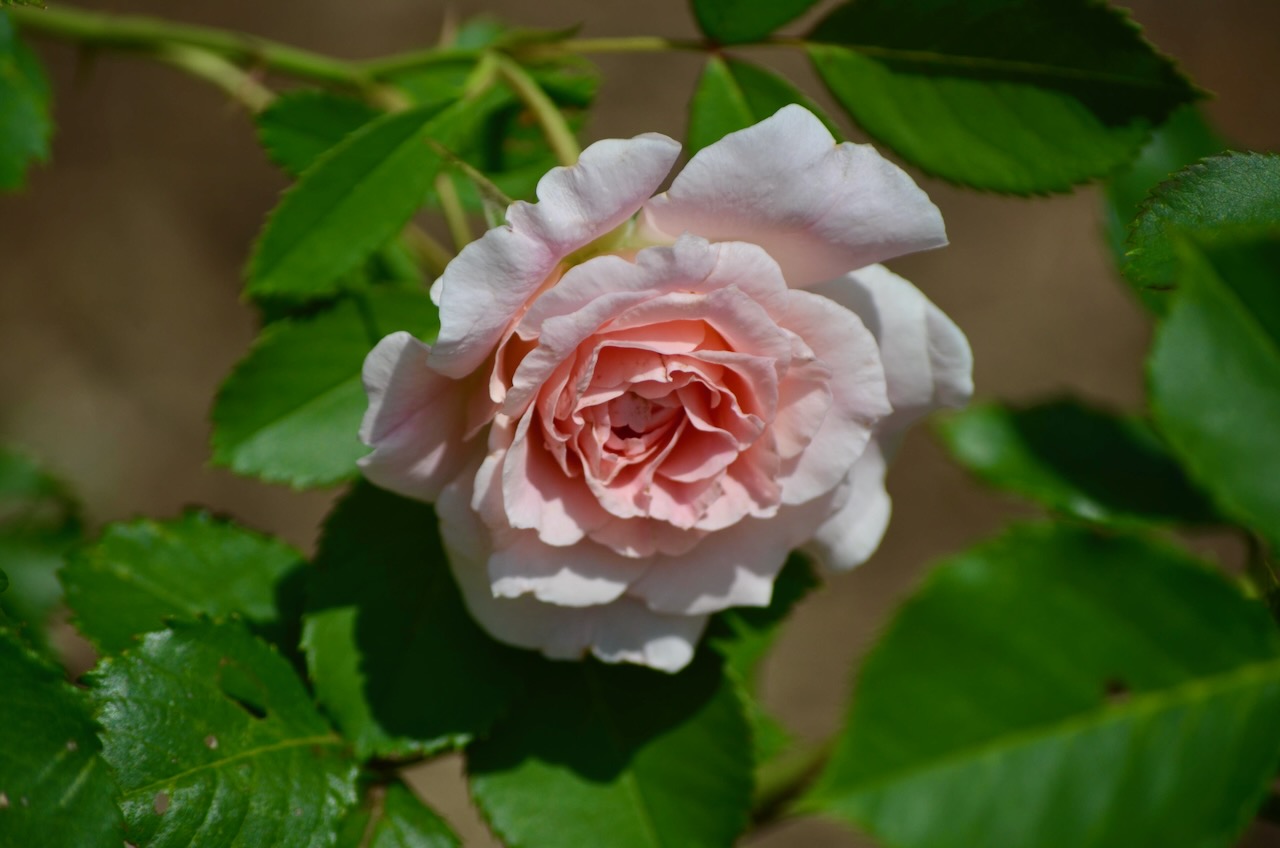
In researching this, I discovered Ralph Moore created the resistant Fuzzy Wuzzy Red and Moore's Striped Rugosa, is creator of the entire category of moss roses (see Ralph Moore: Father of the Miniature Rose), and donated funds and rose germplasm to the Rose Breeding and Genetics Program at Texas A&M University. He also created the Mermaid rose, a more manageable climbing rose related to the invasive McCartney Rose (R. bracteata), this enabled him to produce more beautiful crosses such as the Pink Powderpuff as detailed in Rosa Bracteata: a Vicious, Feral Beauty, Tamed at Last! -- unfortunately there is not yet scientific study of these roses' resistance.
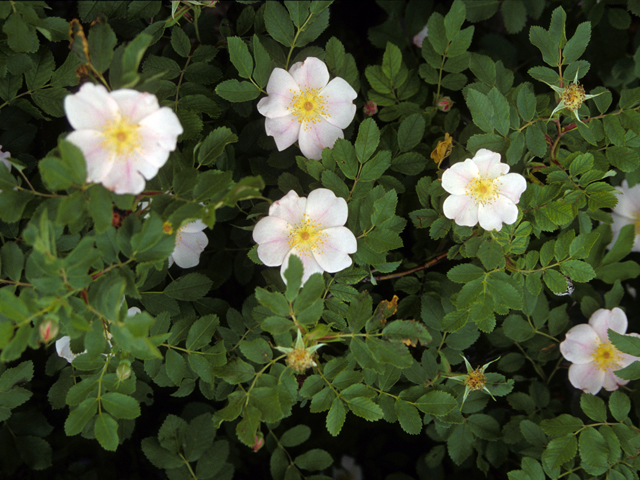
Below are a selection of resistant roses:
| Variety | Susceptibility | Kind | Zones | Height |
|---|---|---|---|---|
| R. carolina FF | None | Pasture | 5+ | 3-6' |
| R. bracteata RM | None | |||
| Fuzzy Wuzzy Red | None | Moss | 5b-10b | 1' |
| Purple Pavement | None | Hybrid Rugosa | 3b+ | 5' |
| Morden Blush | None | Shrub | 3a+ | 4' |
| Chuckles | None | Floribunda | 5' | |
| Sir Thomas Lipton | None | Hybrid Rugosa, Shrub | 4b+ | 5-8' |
| R. virginiana FF | None | 3-6' | ||
| R. folialosa ARE | None | |||
| R. woodsii RVR | None | 4-5' | ||
| Fairy Moss | Low | Miniature, Polyantha | 5b+ | 2' |
| Star Delight | Low | Hybrid Rugosa | 2' | |
| John Davis | Low | Hybrid Kordesii | 2b+ | 7' |
| Moore’s Striped Rugosa | Low | Hybrid Rugosa | 5b-10b | 4-5' |
| Basye’s Blueberry | Low | Shrub | 5a-9b | 5-8' |
| Winnipeg Parks | Low but Positive | Shrub | 2b+ | 3' |
Native roses include R. wichuraiana thornless, the Prarie Rose (R. arkansana), the Carolina Rose (R. carolina), the White Prarie Rose (R. foliolosa), the Virginia Rose (R. virginiana), and Woods' rose (R. woodsii).
Some resistance roses include: Top Gun, Basye’s Blueberry, John Davis Hardy Rose, Purple Pavement Rugosa Rose, Sir Thomas Lipton, Thérèse Bugnet Rugosa Rose, Moore’s Striped Rugosa, Chuckles Hardy Rose, Fairy Moss, Stormy Weather, Bonica (resistant to the mite, not the pathogen), Morden Blush, Winnipeg Parks developed from native prarie roses.
Those which were symptomatic in the trial but no RRV was detected include: Caldwell Pink, Lafter, Manetti, Morden Fireglow.
Awareness
To help improve awareness, I've created a Symptomatic Rose Map, and will be sharing an information packet including the above fact sheets with rose growers in my neighborhood. I am not an expert, not all diagnoses will be accurate.
-
Results are taken from the study Field Resistance to Rose Rosette Disease as Determined by Multi-Year Evaluations in Tennessee and Delaware states the following:
Among those with no or low symptom development are nine species accessions. Accessions of five North American species (R. arkansana, R. carolina, R. folialosa, R. virginiana, and R. woodsii) and one Asian species (R. rugosa) belong to two closely related sections, Carolinae and Cinnamomeae. Previous work has reported that accessions of several North American species from the subgenus Carolinae (R. arkansana, R. blanda, R. carolina, R. californica, and R. palustris) did not show symptom development when they were grafted with infected buds, indicating that there are strong sources of resistance to RRD among this group of rose species native to North America.
Another large group of accessions with low symptom development is the hybrids with R. rugosa (‘John Davis’, ‘Fuzzy Wuzzy Red’, Moore’s Striped Rugosa (‘MORbeauty’), Purple Pavement (‘HANpur’), ‘Sir Thomas Lipton’, Star Delight (‘MORstar90’), and ‘Therese Bugnet’).
The final two accessions that developed no or low symptoms of RRD over the 3-year trial were the floribunda rose Chuckles (‘SIMmimi’) and the miniature rose Fairy Moss (MORfairpol’)
Based on current data, the following rose cultivars have shown no symptoms or detectable virus: ‘R. arkansana FF,’ ‘R. bracteata RM,’ ‘Fuzzy Wuzzy Red,’ ‘Purple Pavement,’ ‘Morden Blush,’ ‘Chuckles,’ ‘Sir Thomas Lipton’ and selections of ‘R. virginiana FF,’ ‘R. folialosa ARE,’ ‘R. carolina FF’ and ‘R. woodsii RVR.’
These species were incorporated by crosses with a local accession of R. arkansana as well as through his use of the roses ‘Prairie Princess’ and ‘Assinboine’. ‘Morden Blush’ and ‘Winnipeg Parks’ showed few symptoms, whereas ‘Morden Centennial’ and ‘Morden Fireglow’ showed moderate symptom development.
Those cultivars showing moderate RRD symptoms without a positive RRV diagnosis were ‘Caldwell Pink’, ‘Lafter’, Manetti, ‘Morden Fireglow’, and Sorcerer (‘SAVasorc’). These roses generally developed rosettes of an RRV infection but not until late in the trial.
In each of the native varieties, R. abbreviates "rosa," part of the scientific name, and the letters which follow the name indicate the source of each specimen:
↩︎Code Source ARE Antique Rose Emporium Bailey Baileys Nursery FF Forest Farm FPS Foundation Plant Services RM Ralph Moore RVR Rouge Valley Roses